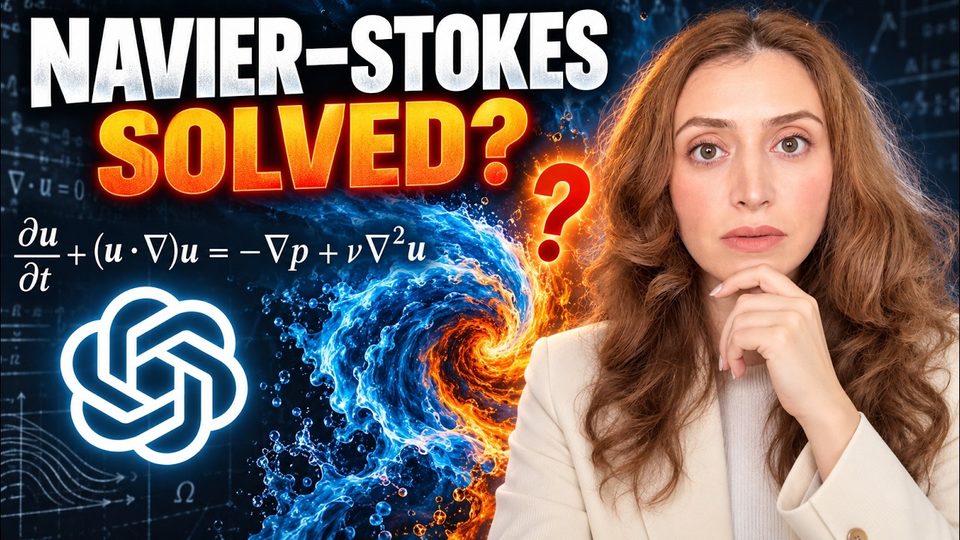
Watch the video with chapters & transcript →
AI TOOLS
Did OpenAI Really Solve the Navier-Stokes Millennium Problem?
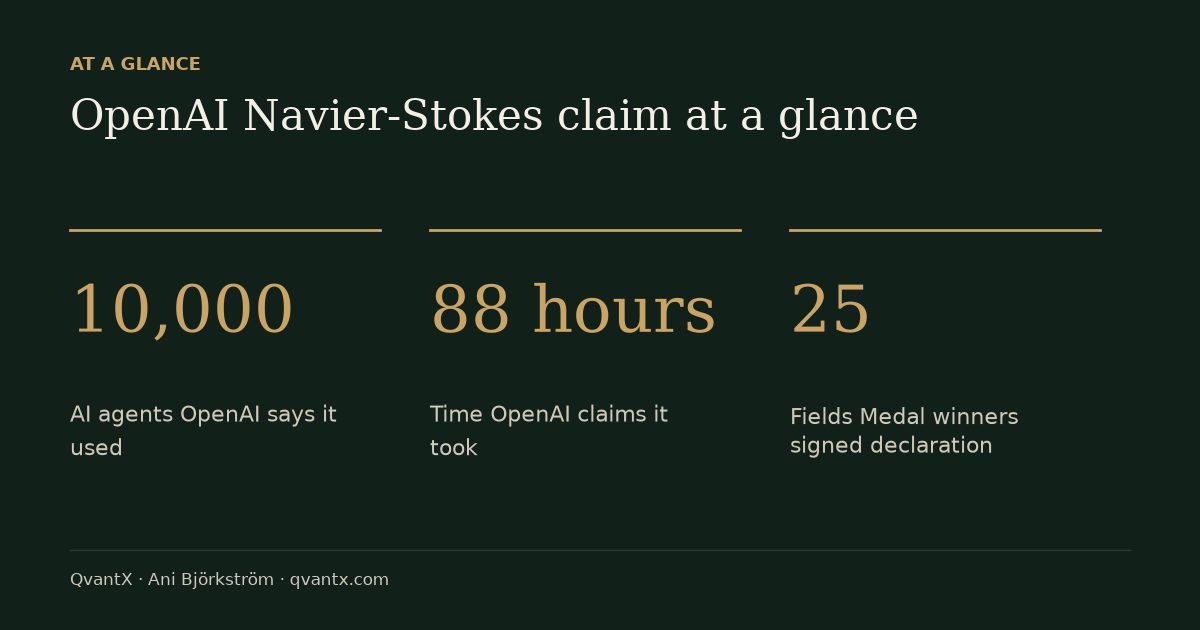
In short: Not yet: OpenAI claims 10,000 AI agents solved the $1 million Navier-Stokes Millennium Prize Problem in 88 hours, but as of the video nobody outside OpenAI has verified the proof. No mathematician has said it is wrong either. Tristan Buckmaster alleges pressure over credit, and 25 Fields Medalists criticised how the result was announced.
Key takeaways
- OpenAI says 10,000 AI agents solved the $1 million Navier-Stokes Millennium Prize Problem in 88 hours, but no independent mathematician has verified the proof.
- NYU mathematician Tristan Buckmaster alleges an OpenAI researcher told him to remove his research partner Levent Alpöge's name or "ruin your career."
- 25 Fields Medal winners, including Terence Tao, signed a declaration accusing AI companies of using famous problems as "marketing proof points."
Ani Björkström, the Stockholm-based AI consultant behind the YouTube channel "Ani Björkström | AI for Finance," breaks down the OpenAI Navier-Stokes controversy not as a mathematician, but as someone who works in finance and recognizes the pattern: a huge result announced before anyone could check it, built by a method nobody outside the company can see. The video walks through what OpenAI actually posted, what Tristan Buckmaster says happened in his calls with OpenAI, what Terence Tao and 25 Fields Medalists wrote in their declaration, and a plain scoreboard of what is confirmed versus what is still just a claim.
What did OpenAI actually claim about Navier-Stokes?
On September 8, 2026, OpenAI posted on X that it had solved the Navier-Stokes problem using roughly 10,000 AI agents working together for 88 hours. The post was seen by 73 million people, according to the video.
The Navier-Stokes equations describe how water, air, and blood move, and are used daily in weather forecasting, aviation, and medicine — yet nobody has ever proven they always produce a stable solution. It is one of seven Millennium Prize Problems, each carrying a $1 million reward, and only one of the seven has ever been solved. Björkström notes that while headlines call it a "90-year-old problem," she could not find the source of that number: the equations themselves are roughly 200 years old, and the Millennium Prize itself is 26 years old.
What does Tristan Buckmaster allege happened?
Tristan Buckmaster, a mathematician at New York University, says OpenAI's announcement followed months of his own unpublished work on the same problem. He had been collaborating since August with a research partner, Levent Alpöge, who works at Anthropic — OpenAI's rival — and says OpenAI began its push only after learning the two were close to a result.
According to Buckmaster's four-page statement, he alleges the OpenAI model used the same method he had developed, that he directly asked OpenAI whether its model had read his notes, and that an OpenAI researcher gave him an ultimatum: remove Alpöge's name from any credit or forfeit the prize. When he refused, Buckmaster says the researcher told him, "Why would you ruin your career?" Sébastien Bubeck replied to the allegations on X on OpenAI's behalf. Björkström stresses these are claims from one man, not established facts.
What did the 25 Fields Medalists say?
Days after Buckmaster's statement circulated, 25 Fields Medal winners — the highest honor in mathematics — signed an open declaration titled "A Severe Misalignment of AI in Mathematics," published on Terence Tao's blog on September 11, 2026. Notably, the signatories do not claim the proof itself is wrong.
Instead, they say the result was announced before anyone could check it, that no proper write-up exists, and that other contributors did not receive credit. Terence Tao, often called the greatest living mathematician, said AI companies are using famous problems as "marketing proof points" — using his words, selling a product rather than advancing science. OpenAI has since canceled its sponsorship of a university math competition, per the video.
Has anyone actually verified the proof?
No. As of the video's recording, nobody outside OpenAI has checked the proof, and no mathematician — including the signatories of the Fields Medalists' declaration — has said it is wrong. Björkström's point is that both things can be true at once: the result could be genuine and historic, and the process could still have been handled badly, which is exactly what 25 of the world's top mathematicians are arguing.
Her conclusion echoes Tao's phrase directly: a result nobody can independently check is "not true and it is not false. It is just useful" — a framing she says finance professionals should recognize immediately from unverified claims in their own industry.
| Event | Source | What happened |
|---|---|---|
| OpenAI announcement | OpenAI post on X, Sept 8, 2026 | Claims 10,000 AI agents solved Navier-Stokes in 88 hours; seen by 73 million people |
| Buckmaster's statement | 4-page PDF, cims.nyu.edu | Alleges OpenAI used his method and pressured him over partner credit, including the "ruin your career" quote |
| OpenAI's response | Sébastien Bubeck reply on X | OpenAI representative responds to Buckmaster's allegations |
| Fields Medalists' declaration | Terence Tao's blog, Sept 11, 2026 | 25 Fields Medal winners say the result was announced before verification and without proper credit |
| Verification status | As reported in the video | No independent mathematician has confirmed or refuted the proof |
FAQ
What is the Navier-Stokes Millennium Prize Problem?
It is one of seven Millennium Prize Problems, each worth $1 million, asking whether the Navier-Stokes equations — which describe how water, air, and blood move — always produce stable, well-behaved solutions. Only one of the seven Millennium Prize Problems has ever been solved.
Who is Tristan Buckmaster and what does he allege?
Tristan Buckmaster is a mathematician at New York University who had been working on the Navier-Stokes problem since August 2026 with research partner Levent Alpöge, who works at Anthropic. He alleges OpenAI's model used his method, and that an OpenAI researcher pressured him to drop Alpöge's name from credit, warning him, "Why would you ruin your career?"
What did Terence Tao say about AI and mathematics?
Terence Tao co-signed a declaration with 25 Fields Medal winners arguing that AI companies use famous unsolved problems as "marketing proof points" — announcing results before independent verification, without proper write-ups, and without crediting other researchers involved.
Read the full video transcript, with chapters, on the video page →
Want this working inside your finance team?

Ani Björkström — founder of QvantX Sweden AB, a Stockholm consultancy building AI solutions for banks, asset managers and finance teams. Anthropic partner. Every article starts from a real client build, minus the confidential parts. LinkedIn →
Keep reading — AI Tools
 What Happens If the AI Bubble Bursts? Your Money, Explained Simply
 Anthropic IPO: Did It Really Lose $80 Billion? The S-1 Explained
 AI Can Now Prescribe Medicine Without a Doctor (Utah Just Made It Legal)
 OpenAI's AI Agent Got Into a Government Portal. That's Not the Worst Part.
More: all 65 articles · How to Scrape LinkedIn Using n8n (Free Template!) - 2026 · Sora 2 is NOW in n8n — No-Code AI Automation Tutorial + Free Template - 2026 · How to create AI YouTube Shorts in MINUTES with HeyGen Video Agent! (No Editing Needed) · How I Automated Faceless Shorts with AI (SORA2) in n8n (free template) - 2026 · work with QvantX