
Watch the video with chapters & transcript →
AI TOOLS
Did Anthropic Really Lose $80 Billion Before Its IPO?
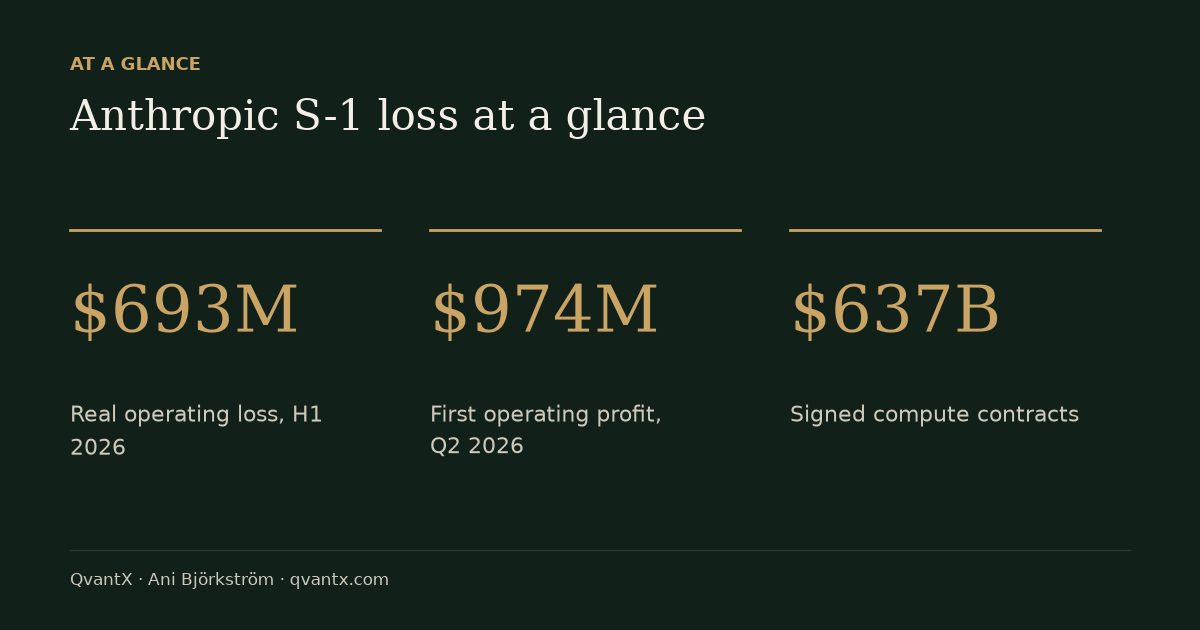
In short: Anthropic did not lose $80 billion in cash: of the $80.7 billion net loss reported for the first half of 2026, about $72 billion is a non-cash accounting charge on convertible notes. Its real operating loss for the six months was $693 million, per its S-1, and the second quarter of 2026 brought its first operating profit, $974 million.
Key takeaways
- No: of the $80.7 billion net loss Anthropic reported for the first six months of 2026, about $72 billion is a non-cash accounting charge on convertible notes; the real operating loss was $693 million, and Q2 2026 was its first operating profit at $974 million.
- Anthropic's revenue grew from $41 million in 2023 to $386 million in 2024, $4.6 billion in 2025, and $16.3 billion in the first half of 2026 alone, with net revenue retention around 900%.
- The S-1 discloses roughly $637 billion in signed compute contracts with Google, Amazon, Microsoft, Broadcom and SpaceX's AI business — while warning that these same suppliers are increasingly also its competitors.
Ani Björkström, the Stockholm-based AI consultant behind the YouTube channel "Ani Björkström | AI for Finance," reads Anthropic's S-1 filing (ticker ANT, filed with the SEC on 26 October 2026) line by line so finance professionals don't have to. As a finance data engineer, she goes straight to the income statement rather than the headline, and the video walks through what the numbers in the actual filing say about Anthropic's growth, its compute obligations, its disclosed risks, and the loss figure that dominated the press coverage.
Did Anthropic really lose $80 billion in six months?
No — the headline number is misleading. Of the $80.7 billion net loss reported for the first half of 2026, roughly $72 billion is a non-cash fair-value adjustment on convertible notes, not cash leaving the business.
Before the IPO, Anthropic borrowed through convertible notes — loans that convert into shares rather than being repaid in cash. Accounting rules require the company to report these notes at current fair value, and because that value rises when Anthropic's own valuation rises, a higher company valuation produces a larger reported "loss" on paper. Strip that out and the real operating loss — revenue minus actual operating costs — was $693 million for the six months, and the second quarter inside that period was already profitable.
How fast is Anthropic's revenue actually growing?
Anthropic's revenue rose from $41 million in 2023 to $386 million in 2024, to $4.6 billion in 2025, and to $16.3 billion in just the first half of 2026. The second quarter of 2026 alone brought in more revenue than the entirety of 2025.
The filing lists more than 11,900 customers paying at least $100,000 per year, and net revenue retention of around 900% — meaning existing customers are paying roughly nine times more than they did the year before, versus roughly 120% at a strong software company. Revenue per employee is around $6.6 million, several times higher than top software firms.
What is the $637 billion compute bill, and is it sustainable?
Anthropic has signed roughly $637 billion in compute contracts with Google, Amazon, Microsoft, Broadcom and SpaceX's AI business — more than the annual government budget of most countries. The key figure is the trend, not the total: in H1 2025, Anthropic spent about $2 on compute for every $1 of revenue; by Q2 2026 that had fallen to 48 cents per dollar of revenue.
That improvement comes from two sources: revenue grew about 14 times year-over-year in Q2 2026 while compute costs grew only about 4 times, and newer Claude models cut customer cost per task by about 40% compared with the previous generation. The result was Anthropic's first-ever operating profit, $974 million, in Q2 2026.
What risks does Anthropic disclose about itself in the S-1?
Anthropic's own filing flags three structural risks: its top five customers make up about 25% of revenue (no single one above 10%), its biggest compute suppliers (Amazon, Google, Microsoft) are also its biggest competitors and may curtail, reprice or terminate supply, and the seven co-founders retain 50.1% of voting power through a special share class, leaving public shareholders with little control. The filing also warns that a catastrophic AI incident could cost more than its insurance covers.
| Metric | Figure | Period / Source |
|---|---|---|
| Revenue | $41M → $386M → $4.6B → $16.3B | 2023 → 2024 → 2025 → H1 2026 (S-1) |
| Net revenue retention | ~900% | S-1, vs. ~120% at top software peers |
| Disclosed compute contracts | ~$637B | Google, Amazon, Microsoft, Broadcom, SpaceX AI |
| Reported net loss vs. real operating loss | $80.7B vs. $693M | H1 2026, S-1 income statement |
| First operating profit | $974M | Q2 2026 (S-1) |
FAQ
Why did headlines say Anthropic lost $80.7 billion?
That is the net loss figure in the S-1 for the first six months of 2026, but roughly $72 billion of it is a non-cash fair-value adjustment on convertible notes that gets larger as Anthropic's valuation rises — not cash the company actually spent.
Was Anthropic ever profitable before the IPO filing?
Yes, on an operating basis: the second quarter of 2026 produced an operating profit of $974 million, Anthropic's first, even though the six-month period still showed a real operating loss of $693 million.
What is the biggest risk Anthropic discloses in its S-1?
The filing states that its biggest compute suppliers — Amazon, Google and Microsoft — are increasingly also its competitors, and that compute could be curtailed, repriced or terminated; it also discloses that its top five customers account for about 25% of revenue and that founders hold 50.1% of voting power.
Read the full video transcript, with chapters, on the video page →
Want this working inside your finance team?

Ani Björkström — founder of QvantX Sweden AB, a Stockholm consultancy building AI solutions for banks, asset managers and finance teams. Anthropic partner. Every article starts from a real client build, minus the confidential parts. LinkedIn →
Keep reading — AI Tools
 AI Can Now Prescribe Medicine Without a Doctor (Utah Just Made It Legal)
 OpenAI's AI Agent Got Into a Government Portal. That's Not the Worst Part.
 US vs. China: AI FIGHT
 Robot Maids in Every Home Soon?
More: all 64 articles · AI Can Now Prescribe Medicine Without a Doctor (Utah Just Made It Legal) · OpenAI's AI Agent Got Into a Government Portal. That's Not the Worst Part. · US vs. China: AI FIGHT · Robot Maids in Every Home Soon? · work with QvantX