US vs. China: AI FIGHT
AI TOOLS
Is the US or China winning the AI race in 2026?
In short: Stanford's AI Index puts the performance gap between the leading US and Chinese models at just 2.7% as of March 2026, even though US private AI investment ($286 billion in 2025) was more than 23 times China's ($12 billion).
Key takeaways
- Stanford's AI Index puts the performance gap between the leading US and Chinese models at just 2.7% as of March 2026, even though US private AI investment ($286 billion in 2025) was more than 23 times China's ($12 billion).
- DeepSeek's much-quoted "$5.6 million" figure for its V3 model only covers assumed chip-rental time — it excludes prior research and is not the cost of the company's reasoning model, R1.
- The US restricted Chinese access to advanced chips again in January 2026, when the Department of Commerce began case-by-case review of exports including Nvidia's H200 — yet Taiwan's TSMC still makes almost all of the world's leading AI chips, a dependency the US shares.
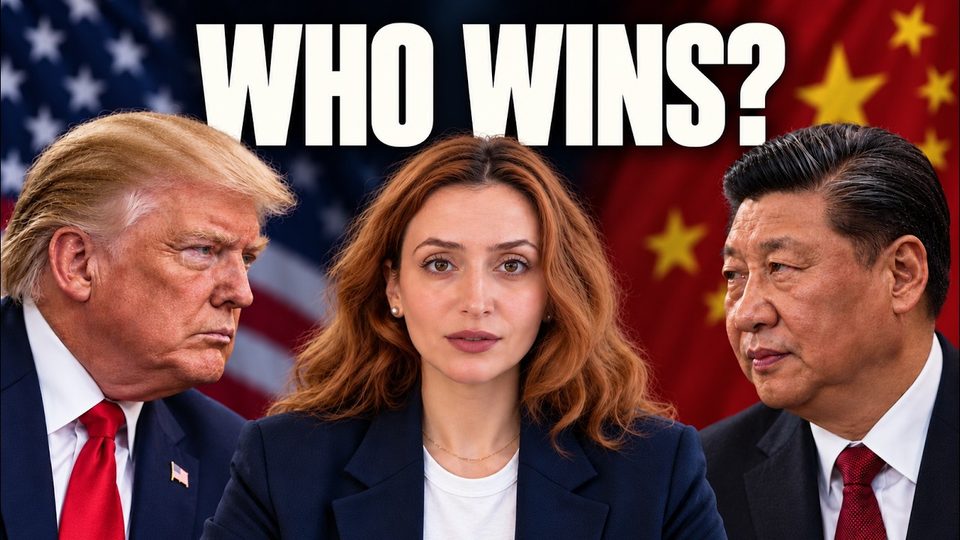
Ani Björkström, the Stockholm-based technology and finance consultant behind the YouTube channel "Ani Björkström | AI for Finance," went back to primary sources — Stanford HAI's 2026 AI Index, DeepSeek's own technical report, the US Commerce Department's January 2026 export rule, and IEA data-centre energy figures — to answer who is actually ahead in the US-China AI race. Rather than repeating headlines about a cheap Chinese model crashing Nvidia's share price, the video traces what the underlying numbers do and don't say, and what that means for the tools finance professionals pay for and the AI vendors they might invest in.
Who is ahead: the US or China, according to Stanford's AI Index?
The US leads on investment and output, but the performance gap between the two countries' best models has nearly closed. Stanford counted 50 notable US models launched in 2025 versus 30 from China, and its March 2026 comparison put the leading US model only slightly ahead — a 2.7% gap.
That lead is not stable. Stanford notes that the leading US and Chinese models have swapped places several times since the start of 2025, and a model that excels at one task, such as a programming problem, can fail at another, such as formatting a simple report. Because of this, Ani Björkström argues the public benchmark leaderboard tells only part of the story that matters to a paying business.
Was DeepSeek's AI model really built for $5.6 million?
No — the $5.6 million figure describes an estimate for DeepSeek's V3 model based on an assumed chip-rental price, not the company's total spending. DeepSeek's own technical report explicitly excludes prior research and experimentation costs, and the figure applies to V3, not to R1, the reasoning model the company released around January 2025.
The video compares using that number to judge the whole industry to comparing an airline's fuel bill with the cost of building the airline. Even so, DeepSeek's R1 weights were released for download under an MIT license, giving other companies a real, usable alternative to paying for a hosted AI service — which is what triggered the roughly $600 billion single-day drop in Nvidia's market value described in the video's framing. Downloadable weights are not free to run, though: hardware, engineering, security and maintenance costs remain, so a hosted service can still be the cheaper option at scale.
Why does Taiwan's TSMC matter more than any single AI model?
Because both the US and China depend on the same physical supply chain to turn any model into a usable product. Stanford notes that Taiwan Semiconductor Manufacturing Company makes almost all of the world's leading AI chips, and many US-designed chips rely heavily on manufacturing there.
In January 2026, the US Department of Commerce announced case-by-case review of some powerful chips, including Nvidia's H200, under security conditions — tightening China's access to advanced computing power. But chip access is only half the physical constraint: the IEA estimates global data-centre electricity consumption was about 485 terawatt-hours in 2025 and projects roughly 950 terawatt-hours by 2030, a reminder that cooling, networking and power capacity take years to build, regardless of how fast a model ships.
What should finance professionals watch to judge who's really winning?
Ani Björkström recommends tracking three signals rather than weekly headlines: the total cost of getting useful work done, access to operational (not announced) computing power, and how easily a customer can switch providers. A cheap model that needs 20 minutes of human correction can end up more expensive than a costlier one that doesn't.
She also flags a lock-in risk that applies to vendors from either country: once a company connects its documents, builds workflows and trains staff around one model, switching stops being "just choosing another chatbot." That is why she frames the decision as a three-way trade-off — capability, total cost, or control over data — rather than a single winner.
| Metric | United States | China |
|---|---|---|
| Private AI investment, 2025 (Stanford HAI) | ~$286 billion | ~$12 billion (state funding likely underestimated) |
| Notable models launched, 2025 | 50 | 30 |
| Leading-model performance gap, March 2026 | Slightly ahead | 2.7% behind the US leader |
| Key constraint | Depends on TSMC (Taiwan) for leading-edge chip manufacturing | Restricted from some advanced chips, incl. Nvidia H200, under Jan. 2026 US export review |
| Notable 2025 release | Hosted and open models from major US labs | DeepSeek R1 weights released under MIT license (downloadable) |
FAQ
Did DeepSeek really train its AI model for $5.6 million?
That figure is DeepSeek's own estimate for V3's training compute, based on an assumed chip-rental price, and it explicitly excludes prior research costs — it is not the company's total spending and does not apply to its R1 reasoning model.
Why did Nvidia's stock drop almost $600 billion in one day?
Investors reacted to DeepSeek's low reported training cost as evidence that powerful AI could be built far more cheaply than assumed, raising doubts about the scale of spending on Nvidia's chips that the market had priced in.
What chip restrictions does the US have on China as of 2026?
In January 2026 the US Department of Commerce announced case-by-case review of exports of some powerful chips, including Nvidia's H200, under security conditions, adding to existing limits on China's access to advanced computing and manufacturing technology.
Full transcript of the video (2,584 words, 15 sections)
0:00 5.6, but US private investment in AI was more than 23 times that of China. The gap between their leading models was only 2.7%. A competition described with two flags depends on a third place. Which one wins? Imagine spending billions to create the world's smartest AI. Then, a competitor releases something similar enough for many customers to use it and allows them to download it. What's happening with your business? That question lies at the heart of the AI race between the United States and China. And the answer could affect the tools you pay for, the companies you invest in, and what your employer expects you to do on a workday. Here's the number that made me stop. Stanford estimates that US private investment in AI was more than 23 times that of China in 2025.
0:53 However, by March 2026, the gap between their leading models was only 2.7%, according to Stanford's comparison . Those numbers measure different things. You can't divide one by the other and calculate who got a better deal. But together, they raise a serious question. How long can a costly advantage remain valuable when competitors keep closing the gap? There is a second question below it. If powerful AI becomes cheaper, who really benefits? You? Your employer? Or the company you can no longer work without? Keep that question in mind because the answer changes as we follow the money, the chips, and ultimately, the customer. First, the United States has real advantages. Stanford counted 50 notable US models launched in 2025 compared to 30 from China.
1:45 Their March comparison also put the leading US model slightly ahead. But Stanford says the leading US and Chinese models have swapped places several times since the beginning of 2025. A narrow lead today may become a different headline after the next launch. And public evidence only tells part of the story. A model could solve a difficult programming problem, then invent a font in a simple report. The best model for one task may be the wrong choice for another. Think about the last time you paid for a premium product. He probably wondered if the difference was worth the price. Companies that choose AI will ask the same question multiplied by millions of requests. That's where this competition becomes uncomfortable for the larger AI companies . Because a challenger doesn't have to win every challenge to take away customers. It needs to become useful, reliable, and affordable enough for the work those customers actually do. In January 2025, a Chinese laboratory gave the world a reason to take that possibility seriously. And then, one number turned a technical pitch into a story that almost everyone misinterpreted. $5.6 million . That was the number associated with DeepSeek, the Chinese AI company that suddenly seemed to challenge the economics of the entire industry. It's understandable why the story spread. Giant American companies were investing huge amounts of money in AI.
3:14 Then, a Chinese competitor appeared to achieve something comparable for a fraction of the cost. It had all the ingredients: an unexpected competitor, powerful companies, and the possibility that someone had spent too much money. But before using that figure, we need to check the receipt. DeepSeek's estimate of about $5.6 million for its V3 model. He used an assumed rental price for processing time on chips. The technical report explicitly excluded previous research and experiments. It was not the total cost of creating the company. And V3 was not R1, the reasoning model launched in January 2024. That distinction is important. Comparing the cost of training with the entire investment behind another company would be like comparing the fuel bill for a flight with the cost of building an airline. But the correction doesn't make DeepSeek any less important. The R1 weights were available for download under an MIT license. Other people could use and adapt the model subject to that license. They had another serious option. Imagine a small software company. This is a hypothetical example. It has a product that customers love, but every interaction costs money because it relies on someone else's AI service . Now, an alternative is available. Perhaps it works well enough for the company's specific tasks. Perhaps the company can execute it economically on its own.
4:39 Suddenly, the team has an option it did n't have before. That choice gives you negotiating power even if you never change suppliers. For a founder who keeps a close eye on costs, that can feel like a relief. For a supplier of models that boasts premium prices, it's a threat worth taking seriously. However , there is a drawback. Downloadable weights do not make running a model free. Hardware, engineering, security, and maintenance are still needed. At certain scales, a hosted service may be the best option. Thus, the competition becomes much more interesting than a cheap model defeating an expensive one. Customers can compare different ways to acquire intelligence. And the more credible those alternatives become, the harder it is to retain a customer simply because they have nowhere else to go. But China faces a restriction that a download button can't eliminate: the hardware behind it all. An AI model can appear on your screen in seconds. The machines that make it possible take years to build.
5:42 Specialized chips, advanced manufacturing, memory, networks, cooling, and reliable electricity are needed . The United States has restricted China's access to certain advanced computing chips and manufacturing technologies. These restrictions can make it difficult to obtain the computing power needed for the most demanding AI systems. The details change. They depend on the product , the customer, and the license. In January 2026, the U.S. Department of Commerce announced a case-by-case review of some powerful chips, including Nvidia's H200 , under security conditions. So imagine being a Chinese AI lab. You are competing against companies that have huge budgets and better access to certain advanced hardware. He has plenty of reasons to make every available chip perform better and to develop alternatives. That pressure can encourage efficiency. It does not guarantee success, and efficient software cannot solve all manufacturing limitations. Now, look at the other side of the map. The United States also has a dependency.
6:45 Stanford notes that Taiwan Semiconductor Manufacturing manufactures almost all of the leading AI chips. Many of the chips designed by American companies rely heavily on manufacturing in Taiwan. A competition described with two flags depends on a third place . This is not a prediction of conflict. It's a reminder that extraordinary software still depends on physical things being manufactured and delivered. A major disruption in that chain would be a serious problem for the industry. Operating a semiconductor factory is much more than owning the building. Skilled workers, tools, materials, maintenance, and international suppliers matter. Then there's the electricity bill. The International Energy Agency estimated that data centers worldwide consumed about 485 terawatt-hours in 2025.
7:36 Its updated projection is approximately 950 terawatt-hours by 2030. That includes all uses of data centers, and the future figure is a projection. The practical point is simple. An investor can approve a budget today. A network connection , a cooling system, or a factory expansion will not necessarily be ready tomorrow. That's why a shiny new model doesn't decide the race. Someone still needs to supply enough computing power to run it for paying customers. The strength of the United States in capital and infrastructure matters. China's progress in efficiency matters. Both face physical limitations, but here 's the twist. Even the company that overcomes those limitations might still have difficulty earning the money it expects. Because possessing the most impressive technology and possessing customer loyalty are two distinct achievements.
8:28 Imagine this. Your company is choosing an AI system. One model gets the highest score in the tests, another costs less and works well in its actual job. A third one is already integrated into the software that everyone uses. Which one wins? The answer might have very little to do with the standings. I work in technology and finance. If I were evaluating these options, I would want to see the entire process. What happens when the model makes a mistake? Who verifies it? Where does the confidential information go? How much engineering is required? What is the cost of a usable end result? A cheap answer that takes 20 minutes to correct can become expensive . An excellent response from a system that no one can integrate may be useless to the team. This is where competition comes into your working life.
9:17 Your employer is unlikely to care which model won a public competition if another model helps the team complete their work more reliably. Chinese companies have helped turn downloadable models into a serious part of that choice. US companies also have significant open models , and Chinese companies also sell hosted services. The market is more complicated than one country being open and the other closed, but greater choice creates pressure. Customers can ask for better prices, more control, or a more user-friendly service . And then something subtle might happen . A company adopts a model because it is affordable. Connect your documents, create workflows, train staff, and add additional software around it. Months later, changing is no longer just a matter of choosing another chatbot. That 's a possible outcome with suppliers from any country. It depends on how the system is built. The model can become cheaper, while moving away from the integrated system becomes more expensive. Think about how many tools you're still using because your entire team already uses them. Familiarity, integration, and the effort to change can matter as much as functions. Therefore, distribution deserves attention. The company around which people build can become very valuable, even if it doesn't produce the highest-scoring model every month. So let's return to the initial question. If AI becomes cheaper, who benefits?
10:44 Initially, customers can gain a lot. Over time, the answer also depends on whether they retain meaningful options. And that brings us to the financial stake behind the whole race. Let's assume that AI continues to improve. Companies are adopting it. Millions of people use it every day. That still doesn't indicate whether every company building AI will be a good investment. This is the distinction that is lost when enthusiasm takes over. A technology can create enormous value while competition makes it difficult for some of its suppliers to make a profit. Stanford estimates that private investment in AI in the US reached about $286 billion in 2025 compared to about $12 billion in China. Those are figures for private investment. They do not capture all national spending. Stanford specifically cautions that state funding means the Chinese total is likely underestimated in that comparison. Even so, the scale of the US investment raises a huge question. What future revenue will justify it? One answer is that more computing power allows for better systems. Better systems unlock valuable work.
11:58 Customers are paying for that value, and demand is growing as AI becomes useful in more places. Another possibility is that capable alternatives will continue to appear and prices will drop rapidly. Customers benefit, but some developers find it harder to recoup their investment. Both outcomes could occur in different companies and tasks. Imagine a business that can suddenly afford to automate work it previously couldn't . Lower AI prices could create a new customer. Now, imagine a current customer switching to a cheaper provider. Lower prices could simply reduce someone else's income. The balance between these effects matters enormously. And the pressure goes both ways. Chinese companies that offer affordable or downloadable models still need to fund research, acquire hardware, and operate their businesses . Popularity alone doesn't pay all the bills. So, here are three possible futures. In one, the most capable models are still much better at valuable work.
13:00 Customers voluntarily pay extra, and leading US laboratories turn their advantages into lasting business. In another, the capacity gap remains small. Buyers are more willing to switch, and competition is pushing prices down. In a third scenario, companies use a mix. They pay more for the most difficult tasks and use cheaper models for routine work. The third one is especially interesting because it gives space for success to different suppliers. It also means that a company can lead the way without supplying most of its daily interactions with AI. That's why it 's so risky to choose a winner based on a single throw. Now, we have enough of an overview to answer the question that really matters to you. What should you look for next? And what would tell you that the balance is shifting? Notice three things. First, the cost of doing useful work.
13:53 Look beyond the price of a single application. How many attempts does the model need? How much human review does it require? How quickly does it produce a usable result? If a supplier drastically improves that total cost, companies have a real reason to switch. Second, access to operational computing power . Advertisements matter less than machines that are installed, connected, and working. Chip supply, manufacturing capacity, and electricity can determine how much of an advance reaches customers. Third, if customers can leave. If a company can change its model without rebuilding everything, the competition can still work in its favor. If switching becomes painfully difficult, the provider has another kind of advantage. Those three signs tell you more than a weekly headline about whether the United States or China wins. This is where the evidence leaves us. The United States has great strengths in private capital, model production , leading companies, and the design of essential chips. China has closed much of the gap measured in model performance and has produced important alternatives that others can download and adapt.
15:05 Taiwan remains crucial for the manufacture of cutting-edge chips. Both sides need physical infrastructure. Both need customers. And none of them achieve a permanent victory by leading a race just once. To someone observing from outside the industry, this may sound distant . It becomes personal when these systems enter your work. Imagine a task that used to take you all afternoon and now your team expects it before lunch. That is one possible effect of a cheaper and more capable AI. It could free up time for better work. It could also raise expectations without giving people much of a say in the change. The country of origin of the model will only be one part of that experience. Accuracy, control, training, and the decisions your employer makes will also matter. So, the conclusion of this whole story is this. Cheaper intelligence can create more opportunities, but the benefits depend on who knows how to use it well and who maintains control over the tools. The smartest chatbot could change next month. The decisions that companies make in this regard can last for years. That's why I would observe the client as closely as the laboratory. Who gets real value? Who captures the profit? And who still retains the freedom to switch when a better option comes along? If you were choosing an AI for your company, what would be most important? The greatest capacity , the lowest total cost, or control over your system and your data? Choose one . Then tell me what you would be willing to give up to achieve it.
Want this working inside your finance team?

Ani Björkström — founder of QvantX Sweden AB, a Stockholm consultancy building AI solutions for banks, asset managers and finance teams. Anthropic partner. Every article starts from a real client build, minus the confidential parts. LinkedIn →