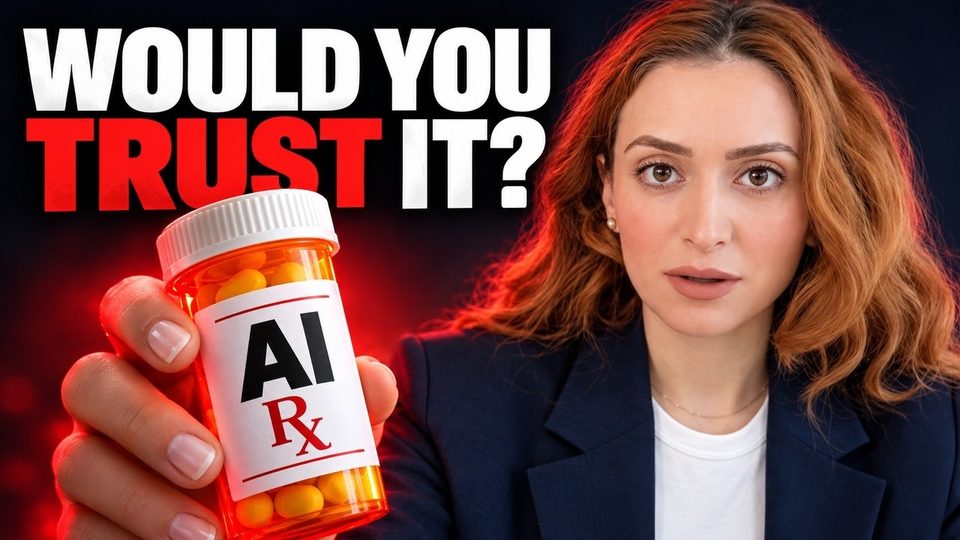
Watch the video with chapters & transcript →
AI REGULATION
Why Does Utah's AI Prescription Ruling Matter for Financial Services Regulators?
In short: Utah's Office of Artificial Intelligence Policy approved a staged-autonomy model for AI decision-making — intensive human review that tapers to spot-checks over time — a template other regulated sectors, including financial services, could adapt for AI-driven credit, advice, or underwriting decisions.
Key takeaways
- Utah's Office of Artificial Intelligence Policy approved a staged-autonomy model for AI decision-making — intensive human review that tapers to spot-checks over time — a template other regulated sectors, including financial services, could adapt for AI-driven credit, advice, or underwriting decisions.
- As of 5 October 2026, Utah authorised Nolla Derm, an app from Nolla Health, to issue brand-new prescriptions for mild-to-moderate acne without a physician reviewing every case in real time — the first such authorisation by a US state regulator.
- Nolla Health reports that licensed clinicians agreed with the AI's treatment recommendation in approximately 96% of recent real-world cases, even as oversight shifts from full pre-approval to sampling-based review.
Ani Björkström, the Stockholm-based AI consultant behind the YouTube channel "Ani Björkström | AI for Finance," breaks down a healthcare regulatory decision with a structure finance professionals will recognise immediately: a government sandbox granting an AI system expanding autonomy in stages, with human review decreasing as trust in the system's track record grows. The video is aimed at anyone evaluating how regulators might eventually treat AI systems that make consequential decisions without a human reviewing every case — a question just as live in lending, advice, and compliance as it is in medicine.
What exactly did Utah authorise Nolla Derm to do?
Utah authorised Nolla Derm's AI to issue initial prescriptions — not refills — for topical acne medication, without requiring a physician to review every single case in real time. Utah residents aged 18 and older verify their identity with a government ID and a selfie, complete a short intake questionnaire, and submit a five-angle face scan; the company says the process takes about 10 to 15 minutes.
If the AI determines the case is mild to moderate acne meeting its criteria, it can prescribe from a fixed list: tretinoin, adapalene, clindamycin with benzoyl peroxide, benzoyl peroxide, and azelaic acid. Oral medications, isotretinoin, and severe acne cases are excluded from the AI's authority entirely. The pilot is priced at $4.99 per month.
How does Utah's staged physician-oversight model work?
Oversight starts at its strictest and thins out as the program scales. In stage one, covering the first 100 patients, two licensed Utah physicians must independently review and approve every AI-generated prescription before it reaches the patient.
In later stages, review shifts first to post-issuance checking, then to sampling only a percentage of cases. Nolla Health states that clinicians agreed with the AI's recommendation in roughly 96% of recent real-world cases, with most disagreements being minor strength adjustments rather than changes to the treatment itself. The agreement also requires monthly reporting, adverse-event reporting within 24 hours, and third-party auditors — the accountability scaffolding regulators are using to justify reduced human review over time.
What access gap is the regulator using to justify less human oversight?
Utah's dermatology access gap is the stated justification: state and company materials cite roughly 100,000 Utahns with active acne at any given time, of whom only about 10% ever see a dermatologist. The average wait for an appointment is reported at 61 days, nearly double the national median, and 11 Utah counties have no dermatologist at all; in-person visits can cost up to $300.
The video notes this is not a Utah-specific problem — more than 80% of US counties are considered healthcare deserts of some kind, affecting over 120 million people. The pattern worth watching for any regulated industry is that a severe access or cost gap is the argument regulators accept for granting an AI system expanding autonomy — the same logic could be applied anywhere access to a licensed professional is scarce or expensive.
Who is liable, and could this spread to other states or sectors?
Liability and accountability questions remain unresolved and are still under discussion among physicians and regulators, according to the video. This is not Utah's first AI prescribing pilot: earlier in 2026, the state authorised a separate system, Doctronic, to handle prescription refills, which drew public criticism from members of the Utah Medical Licensing Board over patient safety and oversight levels. The Nolla Derm pilot goes further by allowing initial prescriptions, not just renewals.
Nolla Health has previously raised $4.5 million in funding, including from General Catalyst, and its app had already been downloaded more than 175,000 times across 44 states under an earlier model that still required clinician approval of every case. The open questions the video poses — whether staged review is safe enough, whether the 96% agreement rate holds as volume rises and human review falls, and how other states respond if outcomes look acceptable — are the same questions any regulator considering a similar sandbox for AI-driven financial decisions will eventually have to answer.
| Stage | What happens | Detail from the pilot |
|---|---|---|
| Patient intake | ID and selfie verification, questionnaire, five-angle face scan | Takes about 10-15 minutes; $4.99/month pilot price |
| Oversight stage 1 (first 100 patients) | Two licensed Utah physicians independently review and approve every AI prescription | Full pre-issuance human review |
| Oversight stage 2 | Post-issuance review | Prescription reaches patient before physician review completes |
| Oversight stage 3 | Sampling a percentage of cases | Lowest level of human review in the program |
| Reported outcome | Clinician agreement with AI recommendation | Approximately 96% in recent real-world cases; most disagreements were strength adjustments, not treatment changes |
FAQ
Which drugs can Nolla Derm's AI actually prescribe?
A fixed list of topical treatments only: tretinoin, adapalene, clindamycin with benzoyl peroxide, benzoyl peroxide, and azelaic acid, for adults 18 and older with mild to moderate acne. Oral medications, isotretinoin, and severe acne cases are excluded entirely.
Is this the first time a US state has let an AI prescribe medicine?
It is the first time a state has authorised an AI to issue an initial prescription. Earlier in 2026, Utah authorised a different system, Doctronic, to handle prescription refills, a program that drew criticism from the Utah Medical Licensing Board over safety and oversight.
Who is liable if the AI prescribes the wrong treatment?
According to the video, liability and accountability questions remain under discussion among physicians and regulators and have not been resolved. The program does require monthly reporting, adverse-event reporting within 24 hours, and third-party auditors as part of its agreement with the state.
Read the full video transcript, with chapters, on the video page →
Want this working inside your finance team?
Ani Björkström — founder of QvantX Sweden AB, a Stockholm consultancy building AI solutions for banks, asset managers and finance teams. Anthropic partner. Every article starts from a real client build, minus the confidential parts. LinkedIn →
Keep reading — AI Tools
 Anthropic IPO: Did It Really Lose $80 Billion? The S-1 Explained
 OpenAI's AI Agent Got Into a Government Portal. That's Not the Worst Part.
 US vs. China: AI FIGHT
 Robot Maids in Every Home Soon?
More: all 64 articles · How to get your dream job in Asset Management Industry! · How I Learn Claude AI on Anthropic Academy | Free Claude AI Courses 2026 · How to use claude design · How to Use Claude Design for Job Applications in 2026 (Beats 99% of CVs) · work with QvantX