Watch the video with chapters & transcript →
AI IN FINANCE
What Happens to Your Money If the AI Bubble Bursts?
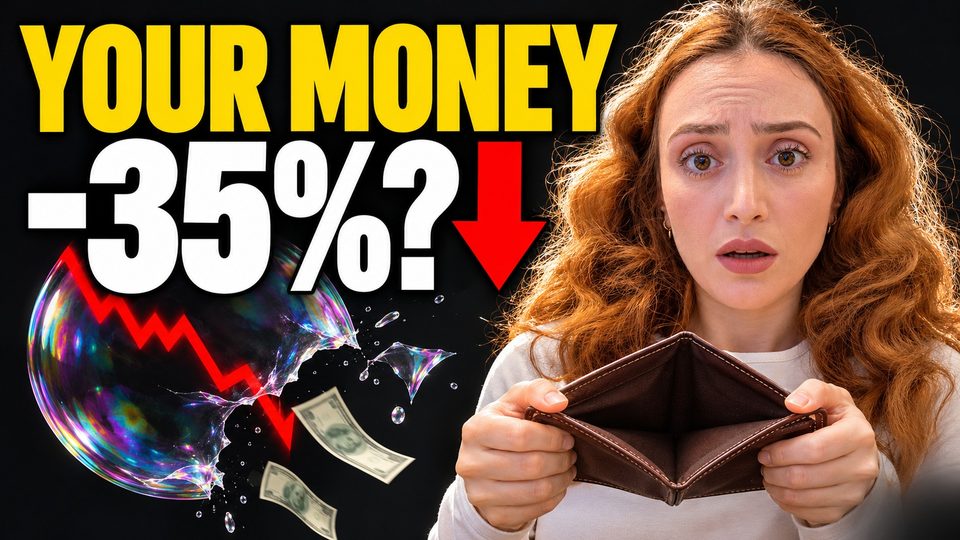
In short: If the AI bubble bursts, money in a normal bank account does not fall, but index funds and pensions do. Seven companies are about 35% of the S&P 500, so a 40% fall in those seven means about a 14% fall in an index fund from them alone. How much it matters depends on when you need the money: in the dot-com crash the Nasdaq fell 78% and took about 15 years to recover.
Key takeaways
- If the AI bubble bursts, money in a normal bank account does not fall. An index fund that follows the S&P 500 does fall, because seven companies make up about 35% of the index: if those seven fall 40%, the fund falls about 14% from them alone.
- Your pension is probably exposed even if you never chose it. US public pension funds hold between $578 billion and $707 billion in AI-related companies, and Nvidia is the largest single holding of Sweden's default pension fund AP7, at about 5%.
- A bubble is about the price, not the product. In the dot-com bubble the internet was real, and the Nasdaq-100 still fell 78% and took about 15 years to return to its peak. How much a fall matters depends on when you need the money.
Ani Björkström, a Stockholm-based finance data engineer and the creator of the YouTube channel "Ani Björkström | AI for Finance," explains what happens to an ordinary person's money if the AI bubble bursts. She goes through five pockets (bank account, index funds, pension, job, home and loans) and explains every term in plain language. This article is education, not personal financial advice. Every number comes from a named source, linked at the end.
What is a bubble, in simple words?
A share is a small piece of a company; "stock" means the same thing. The stock market is the place where people buy and sell these pieces, and the price of a share goes up when more people want to buy it and down when more people want to sell it. A bubble is when the price of something goes far above what it is really worth. People buy because the price went up yesterday and they believe it will go up again tomorrow, not because the company earns a lot today.
Imagine a lemonade stand that earns $100 of profit a year. A fair price to own it might be $1,000 or $2,000. If people start paying $100,000 for it because "lemonade is the future," the lemonade is still real, but the price is far too high. That is a bubble. When it bursts, the price falls quickly back toward what the stand is really worth. The stand still sells lemonade; the person who paid $100,000 has lost most of that money.
Why do people say AI is a bubble?
There are three reasons. First, the spending is enormous: Alphabet, Amazon, Microsoft and Meta plan to spend more than $700 billion in 2026, mostly on data centers (very large buildings full of computers) and chips (Sherwood News, 30 April 2026). The question is not whether AI is useful. It is whether AI will earn that money back. Nobody knows yet.
Second, a few companies have become a very large part of the market. The "Magnificent Seven" (Apple, Microsoft, Nvidia, Alphabet, Amazon, Meta and Tesla) make up about 35% of the S&P 500, a list of 500 of the largest US companies (The Motley Fool, 5 January 2026). That is called concentration: a lot of money sitting in a few places.
Third, some of the money moves in a circle. A chip company invests in an AI company, and the AI company uses that money to buy chips from the same chip company. It looks like growth, but part of it is the same money going around. None of this proves the bubble will burst. It explains why serious people are worried.
What happened in the dot-com bubble?
In the late 1990s the internet was new and everyone believed it would change the world. They were right, but the prices of internet companies went far too high. The bubble burst in March 2000, and by October 2002 the Nasdaq-100 had fallen 78% from its peak (Wikipedia, Dot-com bubble): $100 at the top became about $22 at the bottom. It took about 15 years for the Nasdaq to return to the same level.
Cisco, which made the equipment the internet runs on, was the most valuable company in the world in March 2000, and its share price then fell more than 80%. Amazon fell more than 90%, survived, and rewarded the people who kept their shares. Three lessons: the technology was real and prices still fell; some companies disappeared and some became the biggest in the world; and time mattered more than anything else.
Is my bank account safe if the AI bubble bursts?
Yes, from the bubble itself. Money in a normal bank account is not connected to share prices: 1,000 in the bank is still 1,000. Many countries also have a deposit guarantee, which means the state promises to pay you back up to a limit if your bank fails. The limit is €100,000 per person per bank in the European Union (European Banking Authority) and $250,000 in the United States (FDIC). Check the limit in your own country.
What happens to index funds and the S&P 500?
A fund is a basket: many people put money in, and the basket buys shares in many companies. An index fund simply buys every company on a list, for example the S&P 500. Many people believe that is automatically safe because it holds 500 companies. But if seven companies are about 35% of the list, about 35% of your money is in those seven. If they fall 40%, then 35% × 40% = 14%: the fund falls about 14% from those seven companies alone, which is $1,400 on $10,000. In a real crash other companies usually fall too. Whether that is a disaster depends on when you need the money: next year it hurts, in 20 years it is a bad year in a long story.
What happens to my pension?
A pension fund is the organisation that invests your pension money, and pension funds buy shares, including AI shares. US state and local pension funds held between $578.1 billion and $706.6 billion in AI-related companies as of 30 June 2026, around 10% of their money (Equable Institute via 24/7 Wall St). In Sweden, the default state pension fund AP7 has about six million savers, and its largest single holding is Nvidia at about 5% (AP7 half-year report 2026).
Here age is everything. At 30, a fall means your next payments buy shares at lower prices. At 63, a big fall just before you retire is a real problem, which is why many pension funds slowly move money from shares into bonds as you get older. A bond is a loan to a government or a company that pays you back with interest, and bonds usually move less than shares.
What happens to my job and my home loan?
When share prices fall hard, companies become careful: they spend less, hire fewer people, and some let people go. If many do this at once the economy can shrink, and when it shrinks for several months it is called a recession. After the dot-com bubble burst, many technology workers lost their jobs, so if you work in or sell to technology, your salary and your savings can be hit at the same moment.
The link to your home loan is weaker. A fall in AI shares does not change your loan directly. In a recession, central banks often lower interest rates (the price of borrowing money), so loans can become cheaper, while home prices can fall if many people lose income. This pocket could go in either direction.
What can I check today, before the AI bubble bursts?
Nobody can tell you if or when the bubble will burst. These five checks need no prediction:
- Open your fund or pension and look at the top 10 holdings. If Nvidia, Microsoft and Apple are at the top, you know how much of your money follows AI.
- Ask "when do I need this money?" and write the year down.
- Check your buffer: money in the bank for emergencies, often three to six months of costs.
- Check how spread out you are (diversification): companies outside the United States, and outside technology.
- Decide now what you will do if prices fall 30%, and write it down. The biggest losses come from people who panic and sell at the bottom.
The next big test is Nvidia's results call on Tuesday 17 November 2026 (NVIDIA Newsroom).
| If the AI bubble bursts | Why | |
|---|---|---|
| Bank account | Does not move | Not connected to share prices; deposit guarantee |
| Index funds | Fall, maybe a lot | 7 companies are about 35% of the S&P 500 |
| Pension | Falls; depends on your age | Pension funds hold AI shares |
| Job | Possibly the biggest risk | Companies cut spending and hiring |
| Home and loans | Could go either way | Rates may fall; home prices may fall |
Sources
- Sherwood News, 30 Apr 2026: https://sherwood.news/tech/alphabet-amazon-microsoft-meta-plan-more-than-700-billion-on-capex-this-year/
- The Motley Fool, 5 Jan 2026: https://www.fool.com/investing/2026/01/05/should-investors-be-worried-that-the-magnificent-s/
- Wikipedia, Dot-com bubble: https://en.wikipedia.org/wiki/Dot-com_bubble
- Wikipedia, Cisco: https://en.wikipedia.org/wiki/Cisco
- Wikipedia, History of Amazon: https://en.wikipedia.org/wiki/History_of_Amazon
- Equable Institute via 24/7 Wall St, 6 Nov 2026: https://247wallst.com/investing/2026/11/06/state-pension-funds-have-at-least-578-billion-riding-on-tumbling-ai-stocks/
- AP7 half-year report 2026: https://www.ap7.se/app/uploads/2026/08/halvrsredogrelse-ap7-jan-juni-2026.pdf
- NVIDIA Newsroom, results call 17 Nov 2026: https://nvidianews.nvidia.com/news/nvidia-sets-conference-call-for-third-quarter-financial-results-6928873
- European Banking Authority (EU deposit guarantee) and FDIC (US deposit insurance)
FAQ
What happens if the AI bubble bursts?
Share prices of AI-linked companies fall quickly back toward what the companies are really worth. Bank deposits do not fall, but index funds and pensions that hold those shares do, and companies may cut spending and jobs.
Is my index fund safe if the AI bubble bursts?
Not automatically. About 35% of the S&P 500 is seven companies, so a 40% fall in those seven means roughly a 14% fall in the fund from them alone.
Is my bank account safe?
A bank account is not connected to share prices. Deposits are also protected up to €100,000 per person per bank in the EU and $250,000 in the US.
Does a burst bubble mean AI is fake?
No. A bubble is about the price, not the product. The internet was real and prices still fell 78% in the dot-com crash.
How long did the dot-com crash take to recover?
The Nasdaq took about 15 years to return to its March 2000 level.
Read the full video transcript, with chapters, on the video page →
Want this working inside your finance team?

Ani Björkström — founder of QvantX Sweden AB, a Stockholm consultancy building AI solutions for banks, asset managers and finance teams. Anthropic partner. Every article starts from a real client build, minus the confidential parts. LinkedIn →
Keep reading — AI Tools
 Anthropic IPO: Did It Really Lose $80 Billion? The S-1 Explained
 AI Can Now Prescribe Medicine Without a Doctor (Utah Just Made It Legal)
 OpenAI's AI Agent Got Into a Government Portal. That's Not the Worst Part.
 US vs. China: AI FIGHT
More: all 65 articles · Why Did AI Stocks CRASH? Is the AI Bubble Popping? (The 4 Dominoes) · Anthropic IPO: Did It Really Lose $80 Billion? The S-1 Explained · Claude Dashboards + Snowflake: A CFO Dashboard in 1 Prompt, No Power BI, No Code · Why Are We Still Paying for Power BI? I Tested Claude Dashboards on a Real Excel Report · work with QvantX