Watch the video with chapters & transcript →
AI IN FINANCE
Why Did AI Stocks Crash, and Is the AI Bubble Popping?
In short: AI stocks crashed on 5 November 2026 after three shocks hit at once: US midterm winners pledged to slow AI data centres, investors doubted more than $700 billion of AI spending, and chip stocks priced for endless growth sold off. The S&P 500 lost $2.8 trillion, chip stocks fell 12.3% and Nvidia 9.2% (NBC News). The deciding test is Nvidia's earnings on 17 November 2026.
Key takeaways
- AI stocks crashed on 5 November 2026 because three things hit at once: US midterm winners pledged to slow AI data centres, investors doubted the $700 billion AI spending plan, and chip stocks priced for endless growth fell hardest. The S&P 500 lost $2.8 trillion in one day, chip stocks fell 12.3% and Nvidia fell 9.2% (NBC News).
- A fall of 10% or more is a correction, not yet a burst bubble. The deciding moment is Nvidia's earnings on Tuesday 17 November 2026, because Nvidia sees AI chip orders before anyone else.
- Most people are exposed without choosing it: US state and local pension funds hold up to $706.6 billion in AI-linked companies with Nvidia as the largest single holding, and Sweden's default pension fund AP7 also has Nvidia as its biggest holding (about 5%).
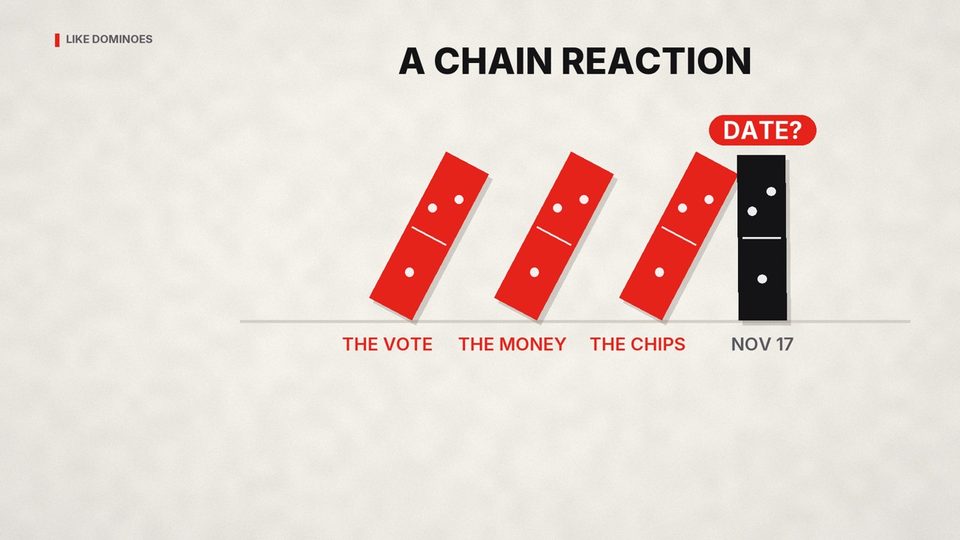
Ani Björkström, a Stockholm-based finance data engineer and the creator of the YouTube channel "Ani Björkström | AI for Finance," explains the AI stock crash of November 2026 as a chain reaction of four dominoes. Three have already fallen: the vote, the money and the chips. The fourth has a date: 17 November, when Nvidia reports its quarterly results. Every number below comes from a primary document or a named news source, linked at the end.
What happened to AI stocks on 5 November 2026?
On Thursday 5 November 2026 the S&P 500 lost about $2.8 trillion in value in a single session. The Philadelphia semiconductor index fell 12.3%, AMD and Micron each fell about 17%, and Nvidia, one of the world's two most valuable companies, fell 9.2%, according to NBC News.
It did not come out of nowhere. It was the end of a chain reaction that had been building for weeks.
Domino 1: why did the US midterms hit AI stocks?
Many winners of the November 2026 US midterm elections had pledged to slow or halt the construction of AI data centres (NBC News). A data centre is a giant warehouse of computers: every ChatGPT or Claude question is answered by one. They use enormous amounts of electricity and share the local power grid, and a May 2026 study reported by ConsumerAffairs found data centres could significantly raise household electric bills. Voters started asking why they should pay more so a tech company can build another AI warehouse. For the first time, AI growth needs permission from voters.
Domino 2: is the $700 billion AI spending sustainable?
Alphabet, Amazon, Microsoft and Meta plan to spend more than $700 billion on capital expenditure in 2026, mostly on AI infrastructure, nearly double the year before (Sherwood News, 30 April 2026). That is almost $2 billion a day. The risk for investors is that a delay does not cancel the cost: a data centre that opens two years late is two years of paying for a building that earns nothing.
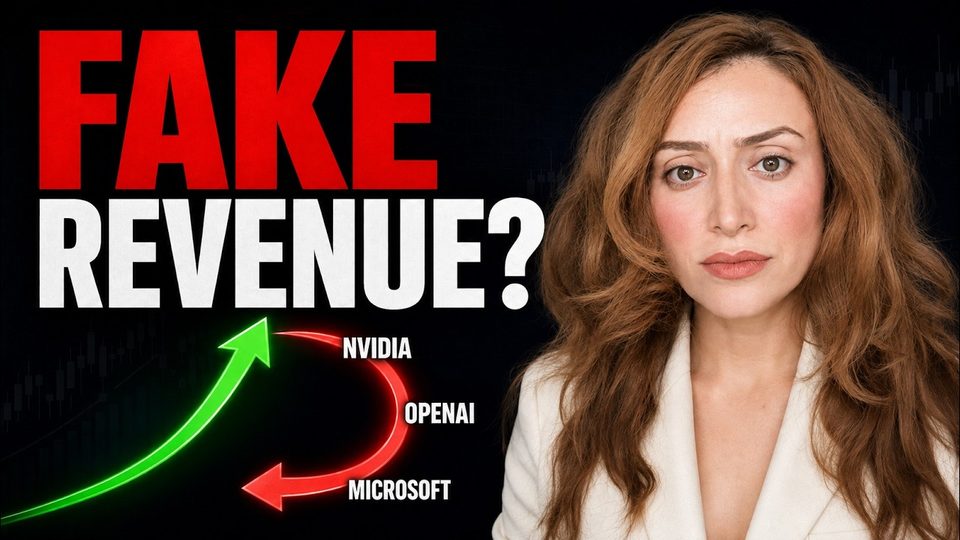
Part of the money also goes in circles. Nvidia announced it intends to invest up to $100 billion in OpenAI, which in turn buys Nvidia systems (NVIDIA Newsroom, 22 September 2025). On paper that looks like booming sales; in reality part of it is the same money coming back around. And Anthropic's own IPO filing (S-1, 26 October 2026) lists about $637 billion in signed computing contracts, future bills that must be paid whether AI demand keeps growing or not.
Domino 3: why did Nvidia, AMD and Micron fall the hardest?
Chip stocks fell hardest because a share price is not what a company earns today; it is what investors pay today for the profits they expect tomorrow. Imagine a lemonade stand that earns $1 a year. If it never grows, paying $40 for it is crazy. If everyone expects that $1 to double every year, $40 looks cheap. Chip stocks are priced for the doubling, so the AI boom does not need to stop for them to fall. It only needs to slow down.
This has already happened in China. The STAR 50 index of AI and semiconductor companies fell about 40% in under four months, wiping out about $480 billion, after trading at nearly 250 times earnings at its peak (Reuters, 26 October 2026).
Is the AI bubble popping or is this just a correction?
Not yet, by the usual definition. A drop of 10% or more is a correction, which happens to tech stocks often and usually does not become a crash. Unlike many dot-com companies, today's AI leaders make real money: Anthropic's revenue went from $41 million in 2023 to $16.3 billion in the first half of 2026 alone (S-1).
The case that it is a bubble: in 2000 the internet was real too. Cisco, which sold the equipment the internet ran on, was the most valuable company in the world in March 2000 and its share price then fell close to 90%; the Nasdaq-100 fell 78% from its peak by October 2002 (Wikipedia, Dot-com bubble). The internet survived; the prices did not. The key distinction is between a technology bubble and a financial bubble. AI will almost certainly survive as a technology. The question is whether the prices survive.
Why do Nvidia's earnings on 17 November matter so much?
Nvidia will host its third-quarter fiscal 2027 earnings call on Tuesday 17 November 2026 (NVIDIA Newsroom). Every company building an AI data centre has to buy its chips first, so Nvidia sees the orders before anyone else. If the numbers are strong, 5 November was an expensive scare. If they show AI spending turning down, that is when a correction becomes the bubble actually popping.
How is my pension exposed to the AI bubble?
If you own an index fund or a default pension, you probably own a lot of AI stocks without choosing them. US state and local pension funds hold between $578 billion and $706.6 billion in AI-related companies, with Nvidia as their single largest position (Equable Institute via 24/7 Wall St, 6 November 2026). In Sweden, AP7 Såfa, the state default pension fund that about six million people are in, has Nvidia as its largest single holding at about 5% (AP7 half-year report 2026, pp. 2 and 8). The seven largest US companies make up about 35% of the S&P 500 (The Motley Fool), so roughly one dollar in three of the American part of a market-tracking fund rides on a handful of AI-linked stocks. Index funds buy companies by size, so as AI stocks rose, pensions automatically bought more of them.
What should I check in my pension this week?
This is not financial advice. Open your pension or fund and look at its top ten holdings. If Nvidia, Apple and Microsoft are at the top, you are betting on AI whether you chose to or not, and the closer you are to retirement, the more a day like 5 November matters.
| Figure | Value | Source |
|---|---|---|
| S&P 500 value lost, 5 Nov 2026 | −$2.8 trillion | NBC News |
| Chip stocks / Nvidia / AMD / Micron | −12.3% / −9.2% / −17% / −17% | NBC News |
| Big Tech AI capex 2026 | more than $700 billion | Sherwood News |
| Anthropic signed compute contracts | about $637 billion | Anthropic S-1 |
| China STAR 50 fall | about −40%, $480 billion | Reuters |
| US public pensions in AI stocks | up to $706.6 billion | Equable Institute |
| AP7's largest holding | Nvidia, about 5% | AP7 half-year report 2026 |
| Nvidia earnings date | Tuesday 17 November 2026 | NVIDIA Newsroom |
Sources
- NBC News, 5 Nov 2026: https://www.nbcnews.com/business/markets/tech-stocks-plunge-ai-midterms-rcna607650
- Sherwood News, 30 Apr 2026: https://sherwood.news/tech/alphabet-amazon-microsoft-meta-plan-more-than-700-billion-on-capex-this-year/
- ConsumerAffairs, 20 May 2026: https://www.consumeraffairs.com/news/data-centers-could-significantly-boost-electric-bills-study-finds-052026.html
- NVIDIA Newsroom, 22 Sep 2025: https://nvidianews.nvidia.com/news/openai-and-nvidia-announce-strategic-partnership-to-deploy-10gw-of-nvidia-systems
- Anthropic S-1, SEC EDGAR, 26 Oct 2026: https://www.sec.gov/Archives/edgar/data/2130357/000162828026067168/anthropicpbc-sx1.htm
- Reuters via The Kathmandu Post, 26 Oct 2026: https://kathmandupost.com/world/2026/10/27/in-china-the-ai-bubble-has-already-burst
- Wikipedia, Dot-com bubble: https://en.wikipedia.org/wiki/Dot-com_bubble
- NVIDIA Newsroom, 28 Oct 2026: https://nvidianews.nvidia.com/news/nvidia-sets-conference-call-for-third-quarter-financial-results-6928873
- Equable Institute via 24/7 Wall St, 6 Nov 2026: https://247wallst.com/investing/2026/11/06/state-pension-funds-have-at-least-578-billion-riding-on-tumbling-ai-stocks/
- AP7 half-year report 2026: https://www.ap7.se/app/uploads/2026/08/halvrsredogrelse-ap7-jan-juni-2026.pdf
- The Motley Fool, 5 Jan 2026: https://www.fool.com/investing/2026/01/05/should-investors-be-worried-that-the-magnificent-s/
FAQ
Why did AI stocks crash in November 2026?
On 5 November 2026 three pressures hit at once: US midterm winners pledged to slow AI data centre construction, investors questioned more than $700 billion of planned AI spending, and chip stocks priced for endless growth sold off. The S&P 500 lost $2.8 trillion, chip stocks fell 12.3% and Nvidia fell 9.2%.
Is the AI bubble popping?
Not yet by the usual definition: a 10% fall is a correction, and leading AI companies earn real revenue. The clearest test is Nvidia's earnings on 17 November 2026; if they show AI spending turning down, the correction could become a bubble bursting.
When does Nvidia report earnings?
Nvidia hosts its third-quarter fiscal 2027 earnings call on Tuesday 17 November 2026, according to the NVIDIA Newsroom.
Is my pension invested in Nvidia?
Very likely, if you are in an index fund or a default pension. US state and local pension funds hold up to $706.6 billion in AI-linked stocks with Nvidia as the largest position, and Sweden's AP7 Såfa has Nvidia as its largest holding at about 5%.
Is AI like the dot-com bubble?
Partly. As in 2000, the technology is real but the spending may be too much, too fast. In the dot-com crash Cisco fell close to 90% and the Nasdaq-100 fell 78%, yet the internet survived. AI is likely to survive as a technology; the open question is whether current prices do.
Read the full video transcript, with chapters, on the video page →
Want this working inside your finance team?

Ani Björkström — founder of QvantX Sweden AB, a Stockholm consultancy building AI solutions for banks, asset managers and finance teams. Anthropic partner. Every article starts from a real client build, minus the confidential parts. LinkedIn →
Keep reading — AI in Finance
 Why Are We Still Paying for Power BI? I Tested Claude Dashboards on a Real Excel Report
 Anthropic IPO & Stock: Is It Really Worth $2 Trillion?
 AI's Circular Financing, Explained — Scam or Not?
 I Tested Claude for Excel: It Fixed My Broken P&L Model
More: all 64 articles · Anthropic IPO: Did It Really Lose $80 Billion? The S-1 Explained · Claude Dashboards + Snowflake: A CFO Dashboard in 1 Prompt, No Power BI, No Code · Why Are We Still Paying for Power BI? I Tested Claude Dashboards on a Real Excel Report · Anthropic IPO & Stock: Is It Really Worth $2 Trillion? · work with QvantX