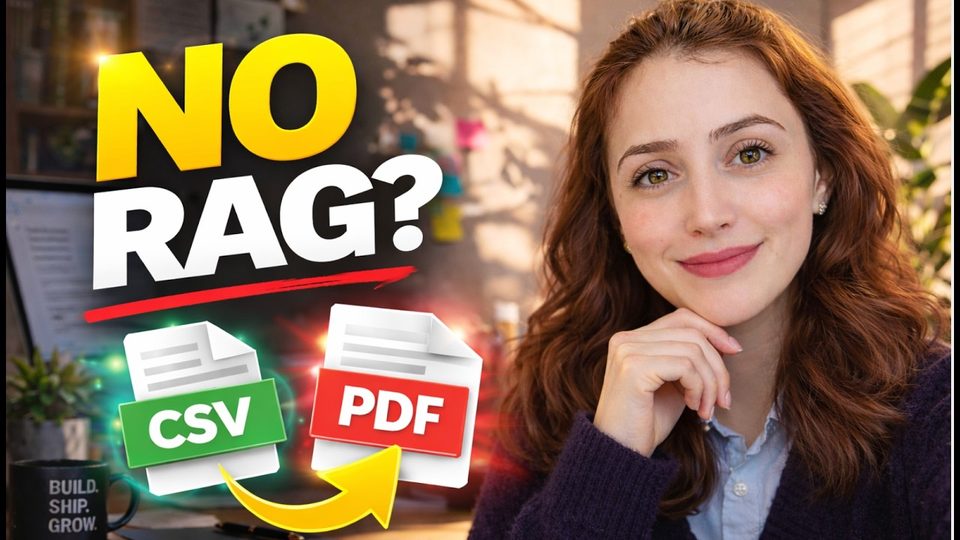
Watch the video with chapters & transcript →
DATA ENGINEERING
Can Claude Projects Replace a Traditional RAG Pipeline?
In short: A Claude Cowork project answered questions correctly across five file formats — PDF, DOCX, XLSX, CSV, and JPEG — with no embeddings, no vector database, and no code.
Key takeaways
- A Claude Cowork project answered questions correctly across five file formats — PDF, DOCX, XLSX, CSV, and JPEG — with no embeddings, no vector database, and no code.
- Claude found a $612 million net income figure on page 5 of a PDF annual report and summed $106,005.65 across 48 CSV rows without being told which file to search.
- Projects connect directly to a folder on your computer, so they accept far larger document sets than a normal chat upload allows.
A traditional retrieval-augmented generation pipeline means chunking documents, generating embeddings, running a vector database, and maintaining all of it as files change. Ani Björkström, a tech consultant based in Stockholm, tested whether Claude Cowork projects can deliver the same result with none of that infrastructure, using a folder of mixed-format finance files.
What is the difference between a Claude project and a normal chat?
Projects accept much larger document sets, because a normal chat has a smaller limit on document sizes. A project also connects to a folder path on your computer, either created from scratch or pointed at an existing catalog, so every file in that folder becomes queryable without individual uploads.
The test project was connected to an existing folder containing five files: a PDF annual report, a DOCX professional services agreement, an XLSX quarterly sales report, a CSV transaction log, and a JPEG invoice. Creating the project and linking the folder takes a few clicks, with no ingestion step to configure.
How accurate is Claude across different file formats?
Claude answered all five test questions correctly, one per file format, without ever being told which document held the answer. In each case it identified the right file on its own and cited where the figure came from, down to the page, section, or sheet.
| File format | Question asked | Claude's answer (verified correct) |
|---|---|---|
| PDF annual report | Net income for 2025 | $612 million, cited from page 5 |
| DOCX services agreement | Termination terms | 60 days prior written notice, per section 2.2 |
| XLSX quarterly sales data | Monthly active users for 2025 | 892,000, from the key KPI sheet |
| CSV transaction log | Sum of the training category | $106,005.65 across 48 rows |
| JPEG invoice | Invoice due date | November 14, 2025 |
The CSV case stands out: Claude aggregated an amount column filtered by category and reported the 48-row count, which matched a manual check of the file. The JPEG invoice shows images work too, with the November 14, 2025 due date read correctly.
Do you still need embeddings and a vector database?
For a document set like this, no — Claude retrieved correct information from every format without any RAG infrastructure to build or maintain. That removes the ongoing maintenance burden of a traditional pipeline: no re-chunking when documents change, no embedding model to manage, no vector store to operate.
For finance teams, this means a controller or analyst can point a project at a folder of reports, contracts, spreadsheets, and scanned invoices and start asking questions in minutes.
FAQ
Do I have to tell Claude which document contains the answer?
No. In all five tests Claude scanned the connected folder, picked the correct document, and cited the location — for example page 5 of the annual report or section 2.2 of the agreement.
Can it handle images and spreadsheets, not just text?
Yes. It read a due date of November 14, 2025 from a JPEG invoice, pulled 892,000 monthly active users from an XLSX KPI sheet, and summed $106,005.65 across 48 CSV rows.
Why use a project instead of pasting files into a chat?
Chat has a smaller limit on document sizes, while a project connects to a whole folder on your computer. That makes projects the practical choice for document sets of any real size.
Read the full video transcript, with chapters, on the video page →
Want this working inside your finance team?

Ani Björkström — founder of QvantX Sweden AB, a Stockholm consultancy building AI solutions for banks, asset managers and finance teams. Anthropic partner. Every article starts from a real client build, minus the confidential parts. LinkedIn →
Keep reading — AI Tools
 What Happens If the AI Bubble Bursts? Your Money, Explained Simply
 Anthropic IPO: Did It Really Lose $80 Billion? The S-1 Explained
 AI Can Now Prescribe Medicine Without a Doctor (Utah Just Made It Legal)
 OpenAI's AI Agent Got Into a Government Portal. That's Not the Worst Part.
More: all 65 articles · How to Scrape LinkedIn Using n8n (Free Template!) - 2026 · Sora 2 is NOW in n8n — No-Code AI Automation Tutorial + Free Template - 2026 · How to create AI YouTube Shorts in MINUTES with HeyGen Video Agent! (No Editing Needed) · How I Automated Faceless Shorts with AI (SORA2) in n8n (free template) - 2026 · work with QvantX